

Centro tecnológico especializado en: • Tecnologías de unión. • Fabricación Aditiva de Metales. • Inspección y Ensayos no Destructivos (END). • Fabricación Inteligente e Industry 4.0.

Products for machine automation and control.

MONDRAGON Corporation.

Community refurbishment and cleaning services

Most read
- 1. Pello Rodríguez advocates for “another way of doing business” at BANG at BIG 2026
- 2. LKS Next is set to exceed 85 million in 2025 following 15 per cent growth, and is forecast to grow by 19 per cent in 2026
- 3. LANA and ETORKI cooperatives have joined together
- 4. Erreka Medical acquires Microliquid to expand in the healthcare sector
- 5. Laboral Kutxa among Spain’s top five banks
- 6. dBot positions Danobat as an international benchmark in next-generation industrial robotics
MONDRAGON shares its circular economy capabilities and best practices at Circular Week 2026
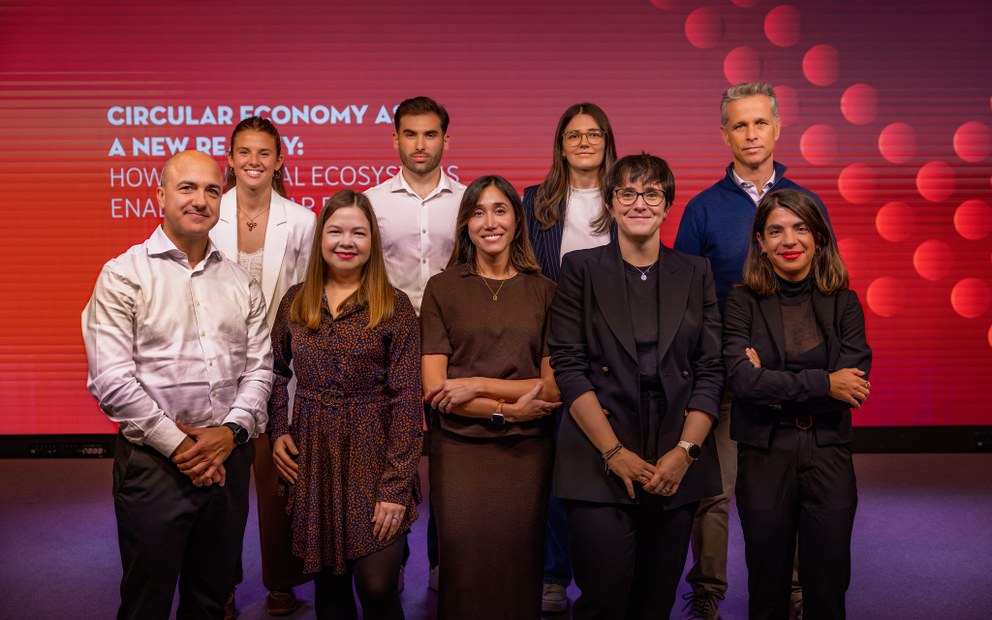
MONDRAGON took part in Circular Week 2026 with a session dedicated to showcasing how industrial ecosystems can help drive the circular economy at scale. Under the title Circular Economy as a New Reality: How Industrial Ecosystems Enable Circular Economy at Scale, the event brought together a range of experiences and solutions developed within the cooperative ecosystem to advance towards more circular production and consumption models.
The session featured professionals from various cooperatives, faculties of Mondragon Unibertsitatea and MONDRAGON technology centres, who shared best practices and capabilities in areas such as digitalisation, product design, extending product lifespans, material recovery and waste prevention.
Photo gallery of the event: https://flic.kr/s/aHBqjD8Ssy
Watch the full session: https://flic.kr/s/aHBqjD8Ssy
Solutions to drive the circular economy
The session opened with a presentation by Carolina Mejía of MONDRAGON Corporation, who discussed the development of industrial ecosystems to promote circularity and the role of intercooperation in connecting capabilities and developing solutions at industrial scale.
Next, Jorge de Antonio of Circular Replay presented the opportunities offered by digital product passports and circular business models. María Fernanda Lardizábal of Circular Replay, representing Copreci, then shared the experience of the LIFE WEEELoop project in recovering and reusing components from cooking hobs at the end of their useful life.

Extending product lifespans through remanufacturing was the focus of the presentation by Daniel de la Torre of Circular Replay, representing Motorlan. Along the same lines, Idoia Urain of Mondragon Unibertsitatea's Goi Eskola Politeknikoa presented methodologies and experiences aimed at promoting remanufacturing across different industrial sectors, with particular emphasis on the automotive industry.
The recovery of high-value electronic components using robotics was the subject of the presentation by Oihane Bañales of LORTEK. Unai de Vicente, from Mondragon Unibertsitatea's MIK research centre, subsequently addressed the recovery of marine plastics and the opportunities to develop new circular value chains.
Finally, Edurne Clemente and Nagore Salegui of Ausolan presented the experience of the GUSTOS project, which focuses on preventing food waste in school canteens by combining innovation, education and changes in consumption habits. The session concluded with a question-and-answer segment.
An international event in a hybrid format
The session was held in English in an interactive hybrid format, combining online and in-person participation. It was streamed online from HUHEZI's facilities in Aretxabaleta from 10:00 a.m. to 12:30 p.m. and was aimed at a European audience interested in learning about real-world industrial experiences.

Through this initiative, MONDRAGON has brought its circular economy capabilities and best practices to an international audience, sharing initiatives driven by its cooperatives, university and technology centres.
The event formed part of Circular Week 2026, which runs from 26 to 31 October, and provided an opportunity to share proposals for integrating circularity into industrial and business processes. Collaboration, technological innovation and the development of new business models are emerging as key elements in scaling up these practices and moving towards a more circular economy.
Centro tecnológico especializado en: • Tecnologías de unión. • Fabricación Aditiva de Metales. • Inspección y Ensayos no Destructivos (END). • Fabricación Inteligente e Industry 4.0.
Products for machine automation and control.
MONDRAGON Corporation.
Community refurbishment and cleaning services
+ related news